Struggle for the Soul of the Postwar South: White Evangelical Protestants and Operation Dixie by Ken Fones-Wolf & Elizabeth A. Fones-Wolf
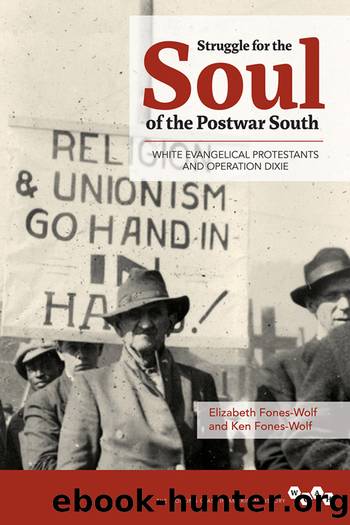
Author:Ken Fones-Wolf & Elizabeth A. Fones-Wolf [Fones-Wolf, Ken & Fones-Wolf, Elizabeth A.]
Language: eng
Format: epub
Tags: Religion, Protestant, Labor & Industrial Relations, United States, 20th Century, Political Science, History, Christianity, General
ISBN: 9780252097003
Google: NmaZBgAAQBAJ
Goodreads: 53369425
Publisher: University of Illinois Press
Published: 2015-03-15T14:09:17+00:00
The CIOâs Southern Crusade
As World War II ended, the leadership of the CIO recognized what the advocates of Christian free enterprise also understood, that the workers of the South represented a critical untapped resource. Whichever group could win the loyalties of southern workers would gain an enormous advantage in the contest over whether or not the nation would resume its march in the direction of liberalism or reverse the direction the nation had taken under Rooseveltâs New Deal. In 1945 CIO leaders in Washington, D.C., could survey the South with some optimism. After all, CIO membership in key southern industries showed positive signs. Major gains in the oil, steel, rubber, automobile, meatpacking, and pulp and paper industries promised a bright future.73 However, these sectors also faced a daunting task, made more difficult by the memories of earlier failures, particularly in the textile industry. In mills across the South, textile operatives remembered the disastrous 1934 general strike in the industry as well as the largely unsuccessful organizing drive of the Textile Workers Organizing Committee, which in 1939 became the Textile Workers Union of America. These failures pointed to just how much might be at stake. By the end of the war, the southern share of the industry had gained significantly at the expense of northern mills, which had 250,000 fewer textile jobs. The garment and woodworking industries were following the same alarming pattern, making union leaders nervous about maintaining union density where it was strong unless they could transform the South.74
Equally urgent for the CIO was the hope of changing the political environment of the South. Laborâs leaders understood that government intervention into labor relations had helped the CIO grow, first with the National Labor Relations Act and then with wartime regulations. They also knew that the recalcitrance of southern Democrats had prevented even more sweeping changes. Throughout the war years, southern congressmen wailed about laborâs efforts to mobilize black and poor white voters for the expansion of New Deal programs. By the end of the war, southern Democratic congressmen helped kill measures that would strengthen the federal governmentâs role in the workersâ compensation and make the Fair Employment Practices Committee a permanent fixture. Moreover, elections in 1938 and 1942 had made the southern congressional delegation even more conservative.75
State-level politics was equally important. As previously noted, Arkansas and Florida led the way in right-to-work laws in 1944, and other states passed antiviolence measures in strike laws and acts inhibiting the freedom of union organizers. As Lucy Mason and CIO organizers knew all too well, state and local officials had routinely participated in efforts to intimidate black and white workers from participating in elections of all sorts, whether for union representation or political representation. But in 1944 the grip of the old politics, which relied on racial and class domination by conservative Democrats, also showed signs of wear. In Georgia the moderate Ellis Arnall defeated the Talmadge regime; in Alabama, blacks mobilized to demand political rights in the wake of the Supreme Court decision (Smith v.
Download
This site does not store any files on its server. We only index and link to content provided by other sites. Please contact the content providers to delete copyright contents if any and email us, we'll remove relevant links or contents immediately.
The Secret History by Donna Tartt(19098)
The Social Justice Warrior Handbook by Lisa De Pasquale(12195)
Thirteen Reasons Why by Jay Asher(8916)
This Is How You Lose Her by Junot Diaz(6892)
Weapons of Math Destruction by Cathy O'Neil(6283)
Zero to One by Peter Thiel(5805)
Beartown by Fredrik Backman(5763)
The Myth of the Strong Leader by Archie Brown(5511)
The Fire Next Time by James Baldwin(5452)
How Democracies Die by Steven Levitsky & Daniel Ziblatt(5223)
Promise Me, Dad by Joe Biden(5156)
Stone's Rules by Roger Stone(5089)
A Higher Loyalty: Truth, Lies, and Leadership by James Comey(4965)
100 Deadly Skills by Clint Emerson(4929)
Rise and Kill First by Ronen Bergman(4793)
Secrecy World by Jake Bernstein(4755)
The David Icke Guide to the Global Conspiracy (and how to end it) by David Icke(4721)
The Farm by Tom Rob Smith(4516)
The Doomsday Machine by Daniel Ellsberg(4492)
